The rapid growth of food delivery, takeaway restaurants, meal preparation services, and online catering has increased demand for reliable food packaging solutions. Choosing the right container material is one of the most important decisions for restaurants, distributors, and packaging importers.
Among the most widely used options in the market are PP Food Containers and PET Food Containers. Both materials offer excellent performance, but they serve different purposes. PP containers are known for heat resistance and microwave suitability, while PET containers are valued for transparency, appearance, and cold food applications.
For businesses searching for takeaway packaging solutions, understanding the differences between polypropylene (PP) and polyethylene terephthalate (PET) can help improve product quality, customer satisfaction, and operational efficiency.
This buying guide provides a detailed comparison of PP and PET food containers, covering heat resistance, food safety, sustainability, cost, durability, and ideal applications.
1. Understanding PP Food Containers
PP, or polypropylene, is a thermoplastic material widely used in food packaging because of its excellent balance between durability, safety, and heat resistance.
PP Food Containers are commonly used for:
- Hot meals.
- Ready-to-eat food.
- Meal preparation services.
- Microwave heating applications.
- Restaurant takeaway packaging.
The structure of polypropylene allows containers to maintain stability under higher temperatures compared with many other plastic packaging materials.
1.1 Main Advantages of PP Containers
The biggest advantage of PP containers is their ability to handle heat.
Many food businesses choose PP because:
- They can safely hold hot food.
- They are suitable for reheating applications.
- They resist deformation better under high temperatures.
- They provide strong protection during transportation.
For takeaway businesses serving noodles, rice dishes, soups, curries, and other hot meals, PP packaging is often the preferred solution.
2. Understanding PET Food Containers
PET, or polyethylene terephthalate, is another widely used packaging material. It is especially popular for products where visibility and presentation are important.
PET Food Containers are commonly used for:
- Salads.
- Fruits.
- Desserts.
- Cold meals.
- Display-ready takeaway products.
The clear appearance of PET makes it attractive for businesses that want customers to see the product before purchase.
2.1 Main Advantages of PET Containers
PET containers offer several benefits:
- Excellent transparency.
- Attractive product presentation.
- Strong rigidity.
- Good protection against external contamination.
- Lightweight transportation advantages.
For supermarkets, cafes, and food retailers, PET packaging can improve product visibility and enhance customer purchasing decisions.
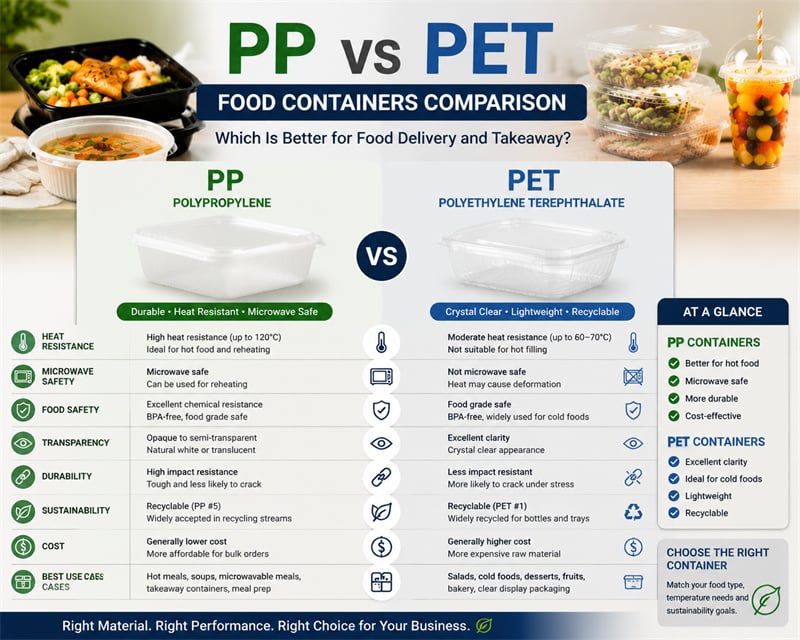
3. PP vs PET Food Containers: Key Comparison
3.1 Heat Resistance
Heat resistance is one of the biggest differences between PP and PET.
PP containers generally perform better in high-temperature environments. They are designed for hot food storage and many microwave applications.
PET containers are more suitable for cold or room-temperature products. Exposure to high temperatures may affect their shape and performance.
For businesses selling hot takeaway meals, PP Food Containers are usually the better option.
3.2 Microwave Safety
Microwave Safe Containers are increasingly important as consumers expect convenience and flexibility.
PP containers are widely selected for microwave applications because polypropylene has strong thermal stability.
PET containers are generally not recommended for microwave heating because they are designed mainly for cold food presentation.
Restaurants should clearly communicate heating instructions to customers to ensure safe usage.
3.3 Food Safety Performance
Both PP and PET can be manufactured for food contact applications when produced according to required food safety standards.
Important considerations include:
- Approved food-grade materials.
- Proper manufacturing processes.
- Quality control testing.
- Reliable supplier documentation.
A trusted packaging manufacturer should provide relevant compliance information before products enter international markets.
3.4 Transparency and Appearance
PET has a clear advantage when visual presentation matters.
Transparent PET containers allow customers to:
- View food quality.
- Identify products quickly.
- See portion sizes.
- Improve retail display performance.
PP containers are usually less transparent, but they provide stronger functional performance for hot food applications.
3.5 Durability and Transportation
Both materials offer good durability, but their strengths differ.
PP advantages:
- Better heat performance.
- Flexible structure.
- Strong impact resistance.
PET advantages:
- High rigidity.
- Excellent clarity.
- Strong appearance retention.
The best choice depends on the supply chain environment and food type.
4. Sustainability Comparison Between PP and PET
Sustainability has become a major factor in packaging decisions. Businesses are increasingly looking for recyclable and environmentally responsible solutions.
4.1 Recycling Considerations
Both PP and PET are recyclable materials when proper collection and recycling systems are available.
PET has historically benefited from well-established recycling systems in many regions.
PP recycling infrastructure is also expanding as demand increases for circular packaging solutions.
Businesses should consider:
- Local recycling systems.
- Customer expectations.
- Environmental regulations.
- Supplier sustainability programs.
4.2 Sustainable Food Packaging Trends
Modern Sustainable Food Packaging focuses on reducing environmental impact throughout the product lifecycle.
Manufacturers are developing:
- Lightweight container designs.
- Recyclable packaging solutions.
- Material-efficient production methods.
- Improved supply chain transparency.
Choosing sustainable packaging can help companies meet customer expectations and strengthen brand reputation.
5. Cost Comparison: PP vs PET
Cost is another important factor for food businesses.
PP containers are often cost-effective for large-scale food service operations because they provide excellent performance for hot food applications.
PET containers may have higher costs in some applications because of their premium appearance and clarity advantages.
The final cost depends on:
- Container size.
- Design complexity.
- Order quantity.
- Material quality.
- Transportation costs.
Businesses should evaluate total value rather than only purchasing price.
6. Which Container Is Better for Food Delivery?
The best packaging choice depends on the type of food being delivered.
Choose PP Food Containers for:
- Hot meals.
- Microwave reheating.
- Meal preparation.
- Soups and sauces.
- Restaurant takeaway.
Choose PET Food Containers for:
- Salads.
- Fresh fruits.
- Desserts.
- Cold dishes.
- Display-focused products.
Many food businesses use both materials to create a complete packaging portfolio.
7. How Importers Should Choose a Packaging Supplier
Selecting a reliable supplier is essential for successful food packaging sourcing.
Importers should evaluate:
7.1 Manufacturing Experience
Experienced manufacturers understand:
- International food packaging requirements.
- Production quality standards.
- Export procedures.
- Customer customization needs.
7.2 Product Customization
Professional suppliers can provide:
- Different sizes.
- Custom colors.
- Logo printing.
- Packaging design support.
Customization helps businesses build brand recognition.
7.3 Compliance Documentation
Before purchasing, importers should request:
- Food contact certificates.
- Material specifications.
- Quality inspection reports.
- Sustainability information.
Complete documentation reduces business risks.
8. Buying Guide Checklist
Before selecting PP or PET containers, consider:
1. What type of food will be packaged?
2. Will customers need microwave heating?
3. Is product visibility important?
4. What recycling requirements apply?
5. What quantity and delivery schedule are required?
6. Does the supplier provide compliance documents?
Answering these questions helps businesses choose the most suitable packaging solution.
FAQ
Are PP Food Containers better than PET Food Containers?
Neither material is universally better. PP is better for hot food and microwave applications, while PET is better for cold food and visual presentation.
Are PP containers microwave safe?
Many PP containers are designed for microwave use, but users should always check product specifications and supplier instructions.
Can PET food containers hold hot food?
PET containers are generally designed for cold or room-temperature applications and are not usually recommended for high-temperature food.
Which material is more sustainable?
Both PP and PET can support recycling systems. Sustainability depends on recycling infrastructure, product design, and responsible manufacturing practices.
Conclusion
PP and PET food containers each offer unique advantages. PP Food Containers provide excellent heat resistance, durability, and microwave suitability, making them ideal for hot takeaway meals. PET Food Containers provide outstanding transparency and presentation, making them suitable for cold foods and retail displays.
For food delivery companies, restaurants, and packaging importers, the right choice depends on product requirements, customer expectations, sustainability goals, and supply chain needs.
By understanding the differences between PP and PET, businesses can select the right takeaway packaging solution, improve customer experience, and build a more efficient food packaging strategy.
CTA:
Need high-quality PP Food Containers or PET Food Containers for your food business? Work with experienced packaging manufacturers to access reliable, customizable, and compliant takeaway packaging solutions.

Dongguan Lvzong: 12+ years’ expertise in R&D, production & supply of full-range eco-friendly disposable supermarket household products.
No. 63, Yinhu Road, Shuishuikou Village, Qiaotou Town, Dongguan City, Guangdong Province
Copyright © Dongguan Lvzong Industrial Co., Ltd. All Rights Reserved Privacy Policy Blog
 EN
EN