Choosing a Food Container Is a Performance Decision
For restaurants, caterers, meal-prep companies and food distributors, choosing a disposable food container is more complicated than selecting a size and price. The container must match the food, temperature, delivery time, storage conditions and disposal requirements.
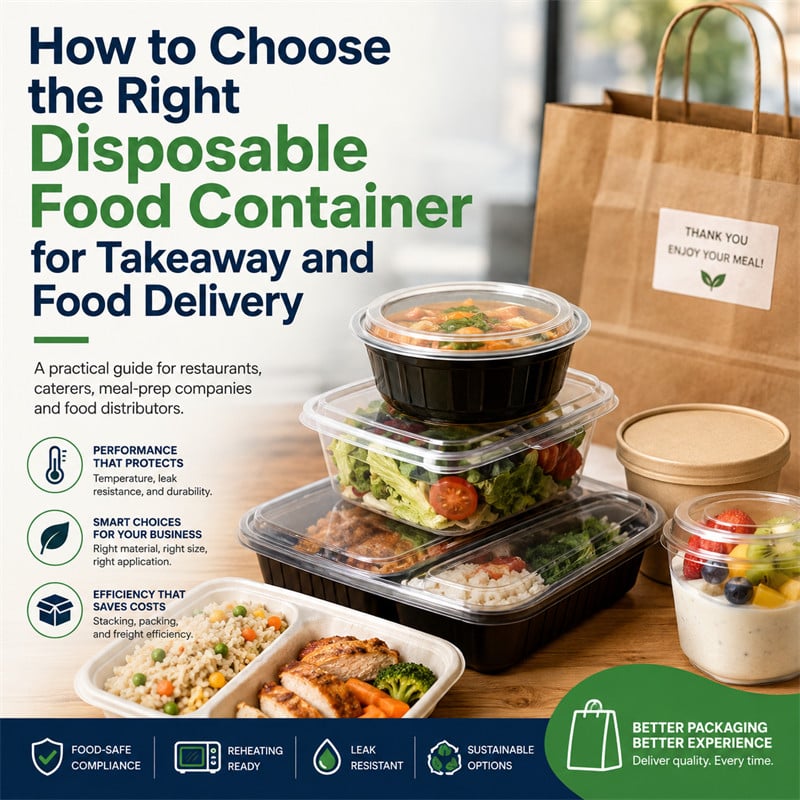
A good specification can improve food presentation and reduce leakage, while a poor match can lead to damaged products, customer complaints and unnecessary packaging costs.
1. Start With the Food, Not the Material
The first question should be what the container needs to hold. Hot rice dishes, soups, oily foods, salads, desserts and sauces place different demands on packaging. Liquid foods require reliable sealing. Crispy foods may need ventilation to reduce condensation. Salads may prioritize clarity and presentation, while meal-prep applications often prioritize compartments and stacking.
Group products by application before selecting the final material. This prevents buyers from choosing a container because it is popular rather than because it is technically appropriate.
2. Check Temperature and Reheating Requirements
If food will be served hot or reheated, temperature performance becomes a core specification. Buyers should ask suppliers for the recommended temperature range and intended use rather than assuming that a plastic container is microwave-safe.
Polypropylene is widely used where heat performance and durability are important. PET is often selected for cold-food applications where clarity and presentation are priorities. Exact suitability depends on product design and specification.
3. Evaluate Leak Resistance and Lid Fit
Leakage is one of the most expensive packaging failures because it can damage other items in a delivery bag and directly affect customer satisfaction. The container body and lid should be evaluated as a system.
Ask for samples and test the intended food or a representative liquid. Close the lid according to supplier instructions and test under realistic handling conditions, including stacking and transport simulation.
4. Choose the Right Size and Portion Format
Oversized containers can increase material use, empty space and shipping costs. Undersized containers can damage presentation and increase spills. The best size leaves enough room for food without creating unnecessary headspace.
For businesses with several menu categories, a coordinated range can simplify procurement. Common footprints and compatible lids can reduce SKU complexity and improve kitchen organization.
5. Consider Compartments for Multi-Item Meals
Compartment containers are useful for meals containing rice, protein, vegetables or side dishes that need separation. They can improve presentation by preventing sauces or wet foods from contacting dry foods.
However, compartments may reduce usable volume compared with an open container of the same external dimensions. Test actual portions before a large order.
6. Compare PP, PET, Paper and Fiber Options by Application
There is no universal best material. PP is frequently chosen for durable hot-food applications. PET is useful where high clarity and cold-food presentation are important. Paper and molded-fiber formats are increasingly relevant where sustainability objectives, regulations or brand positioning favor fiber-based packaging.
Compare the complete system rather than material price alone. Consider unit cost, weight, freight efficiency, accessories, performance, disposal route and customer expectations.
7. Verify Food-Contact Compliance for Your Market
Compliance requirements vary by destination market and intended use. Importers should request appropriate food-contact documentation and confirm that material and product specifications meet the market where the container will be sold or used.
This is increasingly important as packaging regulations evolve. European rules taking effect in 2026 include provisions concerning PFAS in food-contact packaging and broader packaging waste and recyclability requirements.
8. Don't Ignore Stacking, Carton Packing and Freight
A container can perform well on a restaurant counter and still be inefficient in a warehouse. Evaluate nesting, stacking height, carton dimensions, units per carton and pallet configuration.
For international procurement, shipping efficiency can materially affect total landed cost. A slightly more expensive container may be preferable if it nests better, uses fewer cartons or reduces damage in transit.
9. Ask for Samples Before Confirming a Bulk Order
Samples are essential for serious procurement. Test the actual container with the actual menu whenever possible. Check lid fit, filling speed, stacking, reheating performance where relevant, leakage, grease resistance, appearance and disposal instructions.
For custom products, review artwork, dimensions, color, printing quality and packaging marks before mass production.
10. Evaluate the Manufacturer, Not Just the Product
A reliable supplier should provide consistent specifications and communicate clearly about production, quality control, tooling, packaging and lead times. For OEM or private-label projects, ask about mold development, sample approval, artwork workflow, minimum order quantities and inspection.
Supplier reliability matters because packaging is rarely a one-time purchase. Restaurants and distributors need repeatable quality across multiple production batches.
Practical Purchasing Checklist
Define food type and portion size; confirm temperature and reheating requirements; test the container and lid for leakage; check stacking and transport performance; compare materials by application; request destination-market food-contact documentation; review carton and freight efficiency; approve samples before bulk production; confirm OEM and printing requirements; evaluate production capacity and quality control.
Conclusion
The right disposable food container fits the complete operating system: food, kitchen, delivery, storage, customer experience and end-of-life requirements. By testing performance before purchasing and evaluating suppliers on documentation and consistency as well as price, buyers can reduce packaging failures and build a more reliable supply program.
Frequently Asked Questions
What is the best disposable food container for takeaway?
The best option depends on the food. Hot meals may need durable heat-resistant containers, while salads and cold foods may benefit from clear packaging. Delivery time and leak resistance also matter.
Are PP food containers microwave safe?
Many PP containers are designed for hot-food or reheating applications, but microwave suitability must be confirmed for the specific product and supplier specification.
How do I choose the right container size?
Match internal volume to the actual portion. Avoid excessive empty space while leaving enough room to protect presentation and prevent spills.
Should I choose plastic or fiber packaging?
Choose based on application, performance, destination-market rules, disposal infrastructure and total cost. No single material is best for every food.
Why are samples important before a bulk order?
Samples let you test the actual product with your food, equipment and delivery process, reducing the risk of costly quality problems after mass production.

Dongguan Lvzong: 12+ years’ expertise in R&D, production & supply of full-range eco-friendly disposable supermarket household products.
No. 63, Yinhu Road, Shuishuikou Village, Qiaotou Town, Dongguan City, Guangdong Province
Copyright © Dongguan Lvzong Industrial Co., Ltd. All Rights Reserved Privacy Policy Blog
 EN
EN