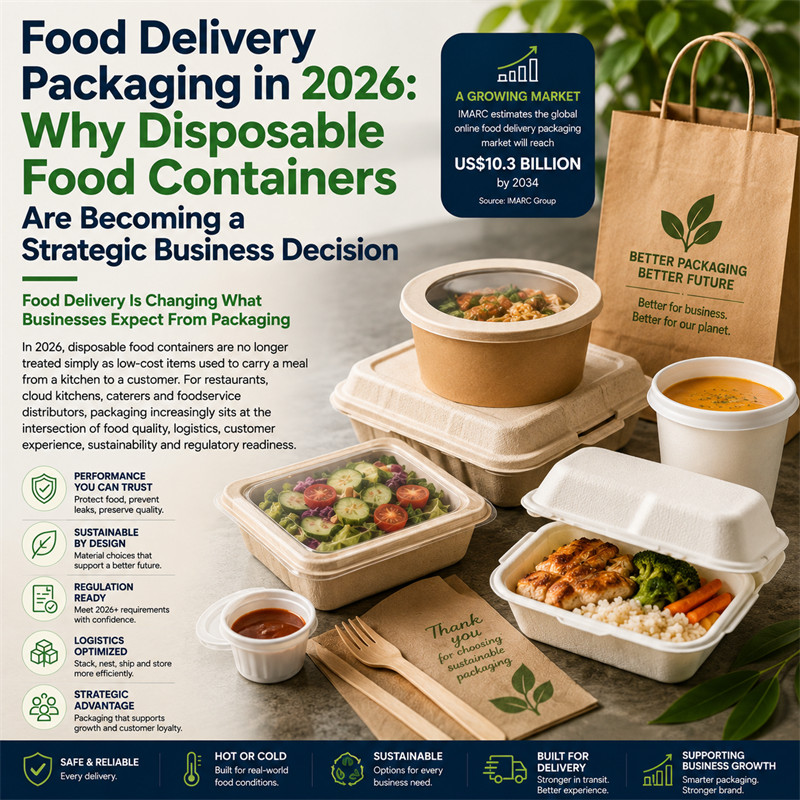
Food Delivery Is Changing What Businesses Expect From Packaging
In 2026, disposable food containers are no longer treated simply as low-cost items used to carry a meal from a kitchen to a customer. For restaurants, cloud kitchens, caterers and foodservice distributors, packaging increasingly sits at the intersection of food quality, logistics, customer experience, sustainability and regulatory readiness.
Recent market research continues to point to food delivery and takeaway as structural demand drivers. IMARC estimates the global online food delivery packaging market reached US$5.3 billion in 2025 and projects it to reach US$10.3 billion by 2034. Other market research also points to continued expansion of disposable food packaging as convenience food and delivery become more established. Sources: IMARC Group; Grand View Research.
1. The Container Has Become Part of the Delivery Experience
A container now has to perform several jobs simultaneously. It must protect food from contamination, control leakage, preserve presentation and withstand handling during picking, stacking and transport. A design that works well in a restaurant may fail when subjected to vibration, pressure or temperature changes during delivery.
For buyers, this is shifting the conversation from price per piece to total packaging performance. Features such as secure lids, stackable geometry, compartment layouts, grease resistance and appropriate thermal performance can reduce complaints and food waste while making kitchen operations easier.
2. Convenience Is Supporting Long-Term Demand
The growth of online ordering has created recurring packaging demand across restaurants, catering operations and delivery-first businesses. Future Market Insights identifies food delivery expansion, quick-service restaurant growth and cloud kitchens among major drivers of disposable food container demand, with foodservice a leading application area.
This means demand is becoming more specialized. A restaurant may need different containers for main courses, side dishes, salads, sauces and desserts. Buyers increasingly value product ranges with compatible lids, coordinated footprints and efficient stacking.
3. Sustainability Is Moving From Marketing Language to Product Requirements
Sustainability remains a major force shaping foodservice packaging, but the conversation is becoming more specific. The Sustainable Packaging Coalition's 2026 report highlights design, innovation, recovery and policy as forces reshaping packaging decisions. Industry coverage also shows growing emphasis on fiber-based formats, recyclability, monomaterial structures, data and traceability.
For buyers, a broad claim such as 'eco-friendly' is less useful than clear information about material composition, recyclability, compostability conditions and certifications. A sustainable package must also work in the actual food application, especially for hot, oily or liquid foods.
4. Regulation Is Increasing the Importance of Supplier Readiness
Regulation is another major consideration. In Europe, new packaging rules taking effect in 2026 address issues including PFAS in food-contact packaging, packaging waste, recyclability and certain single-use formats. Reuters reported longer-term requirements around economically feasible recyclability and waste reduction.
For international buyers, packaging specifications should be reviewed against the destination market before large-scale procurement. Material declarations, food-contact documentation, test reports and recycling or compostability claims should be clear and traceable.
5. PP Still Has an Important Role in Food Delivery
The move toward sustainable packaging does not mean every application can immediately switch to one material. Polypropylene remains widely used for food containers because of its combination of durability, cost efficiency and suitability for many hot-food and reheating applications. Market research identifies PP as a major plastic material in food containers, while PET is commonly associated with cold-food applications where clarity is important.
The right decision depends on application rather than a simple plastic-versus-sustainable comparison. Buyers should evaluate temperature, food type, delivery duration, lid performance, storage, disposal infrastructure and local regulations together.
6. Packaging Design Is Becoming More Logistics-Focused
Delivery creates a different engineering environment from dine-in service. Containers are stacked, transported and sometimes stored for several hours. Poorly matched lids or weak corners can create leakage, while excessive empty space increases transport inefficiency.
Manufacturers are responding with leak-resistant closures, nesting and stacking features, compartment designs and shapes optimized for delivery bags. These details can improve kitchen and last-mile efficiency.
7. What Global Buyers Should Ask Their Suppliers in 2026
A professional procurement process should go beyond unit price. Buyers should ask for material specifications, food-contact compliance, temperature recommendations, lid compatibility, carton packing details, production capacity, quality-control procedures, sample availability and lead times.
For private-label projects, buyers should also confirm printing methods, mold ownership, color matching, artwork requirements and minimum order quantities. A supplier that provides documentation and consistent production is often more valuable than one offering the lowest quotation.
8. What This Means for Food Container Manufacturers
Manufacturers competing internationally should prepare for a more demanding purchasing environment. Product quality remains essential, but buyers increasingly expect evidence: technical specifications, test reports, certifications, transparent material information and reliable production systems.
The strongest suppliers will combine performance, compliance and design flexibility while helping customers select the right material instead of treating every order as a standard commodity product.
Looking Ahead
The food delivery economy is giving disposable food containers a more strategic role in the foodservice supply chain. Demand is being shaped by convenience, delivery growth, sustainability expectations and regulatory change at the same time.
For restaurants and distributors, the priority is no longer simply finding the cheapest container. The better question is which packaging system delivers the right balance of food protection, operational efficiency, customer experience, compliance and total cost.
Frequently Asked Questions
Why is food delivery increasing demand for disposable food containers?
Every delivery order requires packaging that protects food during handling and transport. Growth in delivery and takeaway therefore creates recurring demand.
What should buyers consider when choosing food containers?
Consider food type, temperature, leak resistance, lid fit, stacking, storage, delivery time, material requirements, certifications and local disposal rules.
Is PP still suitable for food delivery in 2026?
PP remains widely used for many foodservice applications, particularly where durability and heat performance are important. Suitability should be confirmed for the specific product.
Are sustainable food containers always better?
Not automatically. The best option depends on application, end-of-life infrastructure, required performance and verified environmental claims.

Dongguan Lvzong: 12+ years’ expertise in R&D, production & supply of full-range eco-friendly disposable supermarket household products.
No. 63, Yinhu Road, Shuishuikou Village, Qiaotou Town, Dongguan City, Guangdong Province
Copyright © Dongguan Lvzong Industrial Co., Ltd. All Rights Reserved Privacy Policy Blog
 EN
EN